Kwik Goal Agility Ladder Review: Is It Worth It?
Kwik Goal agility ladder review for basketball players: specs, pros and cons, who should buy it, who should skip it, and the best alternatives to compare.
 By Colin Foster
Updated November 11, 2026
 By Colin Foster
Updated November 2026
The Kwik Goal agility ladder is a 20-foot by 20-foot footwork ladder aimed at players who want a full-size grid for quick-feet drills. It suits basketball players, coaches and training groups who have room indoors or on a flat outdoor surface and want enough length to run multi-step patterns without constantly resetting. It is less suitable for players who train in tight spaces, need a portable option for travel, or want a very short ladder for basic warm-up work. This review is based on the manufacturer’s listed specifications and common owner feedback patterns, not on hands-on testing.
Kwik Goal Agility Ladder, 20-Feet L x 20-Feet W
Product Overview
The Kwik Goal agility ladder is listed on Amazon under the name “Kwik Goal Agility Ladder, 20-Feet L x 20-Feet W.” The name tells you the most important thing about it: this is a large, full-grid ladder built to cover a wide training area. Ladders of this size are commonly used by soccer, basketball and multi-sport programs, because the extra length lets athletes practice lateral movement, crossovers and multi-directional footwork without repeatedly repositioning the setup.
Agility ladders in general serve a simple purpose. Athletes step through the rungs in set patterns, which trains foot speed, coordination, rhythm and the ability to change direction quickly. For basketball players, that translates into the short, fast steps used on defense, closing out on shooters and sliding laterally while staying low. A ladder of this footprint lets you run longer sequences, which is useful when you want conditioning as well as coordination work in a single session.
Because it is a large ladder, the main decision is not whether it works but whether your space and training style justify the footprint. A 20-foot run is a commitment. Before buying, measure the area where you plan to train and confirm you can lay the ladder flat with clearance on every side.
Key Features & Specifications
The table below lists only the specifications stated in the product name. Where the manufacturer does not publish additional detail, we have not guessed.
| Feature | Specification |
|---|---|
| Product type | Agility ladder (footwork ladder) |
| Length | 20 feet |
| Width | 20 feet |
| Overall footprint | 20 ft x 20 ft (400 sq ft when fully laid out) |
| Intended use | Footwork, speed and coordination drills |
| Brand | Kwik Goal |
Two points deserve attention. First, the stated 20-by-20 dimensions mean this is a grid rather than a single straight line, so you should check whether your intended drills rely on a long linear ladder or a squared pattern. Second, the footprint is large enough that you will likely need a dedicated flat area, such as a gym floor, a driveway pad or a turf or concrete patch. Manufacturers typically recommend laying ladders on level, non-abrasive surfaces, and you should confirm the specific care guidance in the packaging or product documentation before use.
Pros & Cons
Pros
- Large 20-by-20 footprint gives room for long, multi-direction patterns without frequent resetting.
- Suitable for group training, where several athletes can work through the grid at once.
- Useful for combining footwork with longer sequences that add a conditioning element.
- Brand is recognized in youth sports and team training settings.
- Can serve soccer, basketball and other field or court sports with similar movement demands.
Cons
- Requires a large, flat, clear area, which rules out many home and apartment setups.
- Less practical to transport than a short or folding ladder.
- Setup and takedown take more time than with smaller ladders.
- Overkill for players who only need a short warm-up ladder.
- Owners often report that rungs and connection points need periodic checking for wear, especially on hard surfaces.
Performance Analysis
Performance for an agility ladder comes down to three things: how well the rungs stay flat and aligned under repeated foot strikes, how stable the ladder remains on the surface you use, and whether its size actually matches the drills you want to run. Based on the listed 20-by-20 dimensions, the Kwik Goal ladder is designed for distance and pattern variety rather than compact speed sets.
For basketball players, the most useful application is a sequence of lateral and forward-backward patterns that mimic defensive slides and closeouts. A large grid lets you run a pattern, walk back, and repeat it without losing the rhythm of the drill. Coaches often value this for team sessions, because multiple players can rotate through different sections of the grid. The additional length also makes it easier to build a short conditioning element into footwork work, which many players find helpful during the offseason.
Owner feedback patterns for large agility ladders commonly focus on two themes. The first is that the setup is worth the effort when the training space is available and remains dedicated to the ladder. The second is that durability depends heavily on the surface: smooth indoor courts tend to be kinder to the rungs than rough concrete or uneven asphalt. Owners also commonly recommend storing the ladder rolled or flat, out of direct sun and moisture, to extend its life. Treat these as general patterns rather than guarantees, because individual experiences vary with use and conditions.
It is also worth noting what a large ladder cannot do well. If your goal is quick, repeated single-step reactions at close range, a shorter ladder set in a tight area may be more efficient. For a broader look at how drills vary by setup, see Ladder Patterns for Agility: 8 Drills for Faster Basketball Feet and Speed & Agility Ladder Training: A Step-by-Step Guide for Basketball Players.
Who Should Buy This Product?
This ladder is a good fit for several types of buyers. Team coaches who run group footwork sessions will get the most value, because a 20-foot grid accommodates multiple athletes and varied patterns. Players who have access to a gym, a school facility or a private outdoor pad with ample room will also benefit, particularly if they want to combine coordination work with light conditioning.
It is a weaker choice for players who train in a small garage, a bedroom or a shared apartment space, and for anyone who needs to pack their gear for travel between practices. Buyers who want only a short warm-up tool, or who are new to footwork training and prefer a simpler starting point, may find a smaller ladder easier to live with. If you are unsure which size suits you, the comparisons in the Buying Guide below should help.
Buying Guide
Before buying any agility ladder, work through a few practical questions. Start with space: measure the area you will use and leave at least a few feet of clearance on each side so you can move freely at the ends of the grid. Next, consider surface. Flat, smooth, non-abrasive surfaces protect both the rungs and your footwork. Then think about how you will train. If you plan to run long patterns and team sessions, a large grid is useful. If you plan to train alone in short bursts, a smaller ladder may be more practical.
Also consider portability and storage. A 20-by-20 setup is not something you will want to lay out and fold up every day, so it works best as a permanent or semi-permanent fixture in a training area. For a deeper look at how ladder design and surface choice affect training, read Flat Rung Agility Ladder Guide: 7 Setup and Drill Tips for Basketball and Fixed Rung Agility Ladder: Setup, Drills and Buying Tips for Basketball.
Here are three well-known alternatives worth comparing, depending on your needs.
Kwik Goal Mini Ladder is a shorter option at 6 feet by 20 inches. It suits players with limited space or those who want a compact tool for warm-ups and simple patterns. It is easier to store and set up, but it cannot support the longer, multi-direction drills the full-size ladder allows.

Kwik Goal Mini Ladder , 6-Feet L x 20-Inch W
SKLZ Quick Ladder is a 15-foot ladder from a brand widely known in training equipment. It sits between the mini and full-size options in length and offers a more moderate footprint for players who want more room than a short ladder but less than a 20-foot grid.
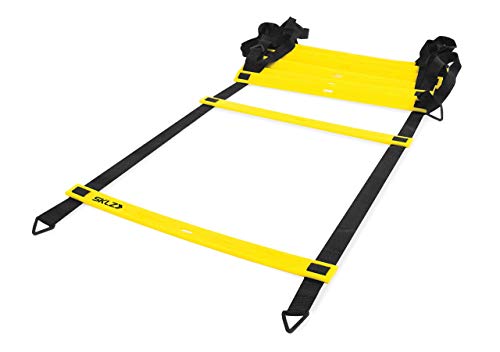
SKLZ Quick Ladder Running-equipment, 15-Feet US, Yellow
Choose the mini ladder for tight spaces and simple warm-ups, the SKLZ Quick Ladder for a balance of length and portability, and the Kwik Goal full-size ladder for team sessions and extended footwork patterns. The right pick depends mostly on your training area and how you plan to use the equipment.
FAQ
How big is the Kwik Goal agility ladder?
The listing describes it as 20 feet long by 20 feet wide, which creates a large grid footprint. Confirm your available space before purchasing, since this is significantly larger than most home-use ladders.
Is this ladder good for basketball footwork?
Yes, for players who have the room. Its size supports the lateral slides, quick feet and multi-direction patterns that carry over to defensive stance and closeouts. It works best when combined with basic defensive movement drills rather than used alone.
Can I use it indoors and outdoors?
It can be used on both, provided the surface is flat and reasonably smooth. Indoor gym floors are generally gentler on the rungs, while rough outdoor surfaces may cause faster wear. Check the manufacturer’s care guidance for specific surface recommendations.
Is it difficult to set up?
Setup takes more time than with a short ladder, because you need to lay out a larger grid evenly and check alignment. Plan for a few minutes at minimum, and more if you are working on uneven ground.
Is a large ladder better than a short one?
Not always. A large ladder offers more pattern variety and suits group work, but a short ladder is easier to store and faster to set up. The better choice depends on your space, your training goals and how often you plan to move the equipment.
How should I store it?
Owners commonly recommend keeping the ladder clean, dry and out of direct sun, and rolling or folding it carefully to avoid creasing or stressing the rungs. Store it where it will not be stepped on or dragged across rough surfaces.
Does it work for conditioning as well as footwork?
It can, because longer patterns and repeated sets raise the heart rate. For dedicated conditioning, pair ladder work with interval sprints or other sport-specific conditioning. If you have a medical condition or are returning from injury, consult a physician, physical therapist or qualified trainer before starting a new program.
Final Verdict
Is the Kwik Goal agility ladder worth it?
For basketball players and coaches with a large, flat training space, the Kwik Goal 20-by-20 agility ladder is a practical choice. Its footprint supports varied, multi-direction footwork and group sessions that smaller ladders cannot match. It is less suitable for players with limited space, frequent travel needs, or only a basic warm-up requirement. Measure your training area first, consider whether a shorter option better fits your routine, and compare the alternatives above before deciding. Based on the listed specifications and general owner feedback patterns, this ladder rewards buyers who have the room and plan to use it regularly.
View on AmazonAbout Colin Foster
Colin Foster is part of our editorial team and reviews and edits our basketball endurance & training gear guides, checking product details against manufacturer specifications and owner feedback.
About the author
Colin Foster writes reviews and buying guides for Basketball Marathon.