5 Best Lateral Shuffle Agility Ladder Options for Basketball (2026)
Compare 5 lateral shuffle agility ladder options for basketball footwork. See key specs, pros, cons and who each ladder suits before you buy.
 By Colin Foster
Updated November 9, 2026
 By Colin Foster
Updated November 2026
Basketball players who want quicker feet on defense need a ladder they can actually set up and use often. A lateral shuffle agility ladder is the most direct tool for that job, because the rungs give you a visible pattern to move through sideways while keeping your hips low and your knees bent. This guide compares five ladders from the current Amazon lineup, using specification sheets, brand reputation and common owner feedback as the basis for each pick. None of these were tested by us; the notes below describe what manufacturers specify and what owners often report.
Our top picks at a glance
- 1TOP CHOICEBest overallSKLZ Quick LadderView on Amazon
- 2
 TOP CHOICEBest for a premium training setupSKLZ Speed and Agility Ladder ProView on Amazon
- 3
 TOP CHOICEBest for a full drill kitAmazon Basics Sports Agility Ladder Speed Training Equipment SetView on Amazon
- 4
 Best budget pickTandem Sport Agility LadderView on Amazon
- 5
 Best for team practiceSpeed & Agility Ladder Training Equipment SetView on Amazon
Our Top Picks
Quick Comparison
| Product | Best for | Key feature |
|---|---|---|
| SKLZ Quick Ladder | General footwork at home or in a driveway | 15-foot length with a straightforward rung layout |
| SKLZ Speed and Agility Ladder Pro | Players who want a shorter, compact ladder | 10-foot length suited to tight spaces |
| Amazon Basics Sports Agility Ladder Set | Players who want hurdles, cones and bands in one box | 20-foot ladder with accessories included |
| Tandem Sport Agility Ladder | Beginners on a limited budget | 10 adjustable rungs for speed and balance work |
| Speed & Agility Ladder Training Equipment Set | Groups and team sessions | 12-rung, 20-foot ladder with cones and a parachute |
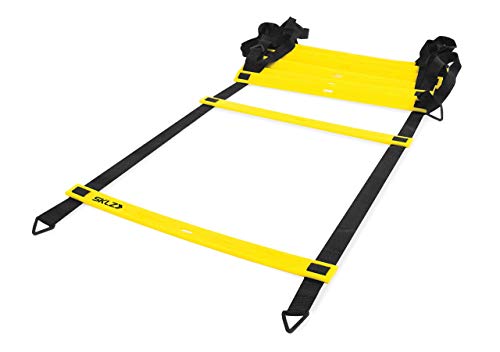
SKLZ Quick Ladder
SKLZ Quick Ladder Running-equipment, 15-Feet US, Yellow
Best for: Best overall for general lateral footwork
This ladder suits players who want a long, flat ladder they can lay out on a driveway, garage floor or gym mat. The 15-foot length gives room for multiple lateral shuffle passes before you turn around, which is useful for building rhythm.
Key specs
- Length: 15 feet
- Style: flat rungs laid on the ground
- Color: yellow
Pros
- Long enough for extended lateral runs
- Simple setup with no assembly
- Works on most flat surfaces
Cons
- Can shift on smooth floors without a few stakes or tape
- Requires a fairly open space
Bottom line: A solid default for players who mainly want to build lateral quickness in a flat, open area.
View on AmazonSKLZ Speed and Agility Ladder Pro
SKLZ Speed and Agility Ladder, Pro, 10'
Best for: Best for a premium training setup in limited space
This model is aimed at players who have less room and want a ladder that packs away easily. The 10-foot length fits in a garage corner or a small indoor area while still allowing a full set of lateral shuffles.
Key specs
- Length: 10 feet
- Style: flat rungs for ground-level drills
Pros
- Compact length for small spaces
- Well-known brand in speed training gear
- Good for footwork at close range
Cons
- Shorter length limits longer drill sequences
- Owners sometimes report it needs anchoring on hard floors
Bottom line: Pick this if you train in a small space and want a dependable brand over the lowest-cost option.
View on AmazonAmazon Basics Sports Agility Ladder Speed Training Equipment Set
Amazon Basics Sports Agility Ladder Speed Training Equipment Set, 20ft Ladder, 4 Hurdles, 12 Cones, Parachute, Jump Rope, 5 Resistance Bands
Best for: Best for a full drill kit
This set is for players who want more than a ladder. It includes a 20-foot ladder, four hurdles, twelve cones, a parachute, a jump rope and five resistance bands, so you can build a complete session without buying separately.
Key specs
- Ladder length: 20 feet
- Included: 4 hurdles, 12 cones, parachute, jump rope, 5 resistance bands
Pros
- Everything needed for a varied session in one box
- Long ladder allows extended lateral drills
- Good for players building a home setup from scratch
Cons
- Accessories are typically lighter-duty than dedicated training brands
- Setup takes more space than a single ladder
Bottom line: Best for players who want a complete starter kit and are willing to trade some durability for variety.
View on AmazonTandem Sport Agility Ladder
Tandem Sport Agility Ladder – Workout Ladder for Quick Feet, High Knee, or Lateral Quickness Drills – 10-Rung Adjustable Agility Ladder for Speed and Balance Training – Speed Ladder for Footwork
Best for: Best budget pick for beginners
This ladder is built around adjustable rungs, which lets you change spacing for lateral shuffle work, high-knee drills and quickness patterns. It suits younger players or anyone just starting footwork training.
Key specs
- Rungs: 10, adjustable
- Uses: lateral, high-knee and speed drills
Pros
- Adjustable spacing supports progression
- Budget-friendly entry point
- Lightweight and easy to store
Cons
- Shorter overall length than larger ladders
- Rung connections may loosen with heavy use, according to some owner reports
Bottom line: A practical first ladder for beginners who want to learn the pattern before investing more.
View on AmazonSpeed & Agility Ladder Training Equipment Set
Speed & Agility Ladder Training Equipment Set, Includes 12 Rung 20ft Agility Ladder, 4 Agility Hurdles,12 Disc Cones, 1 Resistance Parachute for Training Football Soccer Basketball Athletes
Best for: Best for team practice
This set is designed for groups and multi-athlete sessions. The 20-foot, 12-rung ladder pairs with four hurdles, twelve disc cones and a resistance parachute, which helps coaches run stations for several players at once.
Key specs
- Ladder: 12 rungs, 20 feet
- Included: 4 hurdles, 12 disc cones, 1 resistance parachute
Pros
- Enough equipment for station-based team work
- Long ladder supports extended lateral runs
- Covers basketball, soccer and football training
Cons
- Large footprint for a single athlete at home
- Full set takes time to arrange and pack up
Bottom line: Suited to coaches and players who train in groups and need enough gear for several stations.
View on AmazonBuying Guide
Rung Spacing and Ladder Length
For lateral shuffle work, most players do well with a ladder that lets them take two feet into each square without overreaching. Shorter ladders make it easier to finish a set quickly, while longer ladders give you more reps before turning. Measure your open floor first. A 15-foot ladder needs roughly 15 feet of clear space plus a little room at each end.
Good picks for this: SKLZ Quick Ladder, Speed & Agility Ladder Training Equipment Set
Flat Versus Raised Rungs
Flat ladders lie on the ground and are the standard choice for footwork. Raised or elevated designs add a height challenge, but they change your mechanics. For the lateral shuffle, a flat layout keeps the focus on quick, low foot contacts.
Good picks for this: SKLZ Speed and Agility Ladder Pro, Tandem Sport Agility Ladder
Anchoring and Surface
Ladders slide on smooth hardwood and polished concrete. Owners commonly report using tape, small stakes or a rubber-backed mat to keep rungs in place. Indoor gym floors are usually the most stable surface; outdoor asphalt can work well if the ladder is anchored.
Good picks for this: SKLZ Quick Ladder, Amazon Basics Sports Agility Ladder Speed Training Equipment Set
Included Accessories
Sets with hurdles, cones and resistance bands let you build varied sessions, but accessories can be lighter-duty than the ladder itself. If you plan to use hurdles for jumping, check that the frame is stable before loading it.
Good picks for this: Amazon Basics Sports Agility Ladder Speed Training Equipment Set, Speed & Agility Ladder Training Equipment Set
Space and Storage
A 20-foot ladder needs a long, clear strip of floor. If you train in a garage or apartment, a 10-foot ladder may be the more practical choice. Lightweight, flexible ladders are easier to roll up than rigid rails.
Good picks for this: SKLZ Speed and Agility Ladder Pro, Tandem Sport Agility Ladder
Use Case: Solo Training or Team Sessions
Solo players usually need one ladder and a clear floor. Coaches running stations need more cones, hurdles and a consistent setup across several athletes. Match the set to how many people will use it at once.
Good picks for this: SKLZ Quick Ladder, Speed & Agility Ladder Training Equipment Set
Durability and Care
Rung connections and webbing take the most stress. Roll or fold the ladder after each session, keep it out of direct sun for long periods, and check for loose rungs before each use. Owners often report that regular inspection extends service life more than any other step.
Good picks for this: SKLZ Speed and Agility Ladder Pro, Tandem Sport Agility Ladder
FAQ
How long should a lateral shuffle agility ladder be?
A 15- to 20-foot ladder gives most players enough length for several lateral passes. A 10-foot ladder works well for small spaces but offers fewer reps before you need to turn around.
How do I do the lateral shuffle through a ladder?
Stand sideways to the ladder, stay low with your knees bent, and move one foot into each square while the other follows quickly. Keep your chest up and avoid crossing your feet. Start slow and build speed once your footwork is clean.
Can I use a lateral shuffle agility ladder on a basketball court?
Yes, as long as the ladder is anchored or taped so it does not slide. Indoor courts are usually the most stable surface for ladder work.
How often should I train with an agility ladder?
Many coaches suggest two to three short footwork sessions a week, with rest between sets. Keep form the priority. If your footwork breaks down, reduce speed or distance.
Is a flat ladder better than a rung ladder for basketball?
Flat ladders are the standard choice for basketball footwork because they keep the focus on low, quick foot contacts. Adjustable or raised rungs can add variety once the basic pattern is solid.
Do I need hurdles and cones for lateral shuffle training?
Not necessarily. Hurdles and cones add variety, such as shuffling around markers or over low obstacles. Many players start with the ladder alone and add accessories later.
Conclusion
For most basketball players, the SKLZ Quick Ladder is a sound default for lateral footwork on a flat, open surface. If space is tight, the SKLZ Speed and Agility Ladder Pro offers a compact alternative. Players building a complete home kit may prefer the Amazon Basics set, while the Tandem Sport ladder suits beginners on a budget. Coaches running group sessions will get the most from the Speed & Agility Ladder Training Equipment Set. Match the ladder length and accessories to your space and how many people train at once.
Sources
- Physical activity guidelines and recommendations for muscle-strengthening and balance work (cdc.gov)
- Research summaries on agility, footwork and sport-specific conditioning (nih.gov)
- Position guidance on exercise programming and progression for athletes (acsm.org)
Related reading
- Icky Shuffle Agility Ladder: 4 Best Options for Basketball Footwork (2026)
- Ickey Shuffle Agility Ladder: A Step-by-Step Guide for Beginners
- Yes 4 All Agility Ladder Alternatives: 5 Best Picks for Basketball (2026)
- What Is a Body Good Agility Ladder and Is It Worth Using?
About Colin Foster
Colin Foster is part of our editorial team and reviews and edits our basketball endurance & training gear guides, checking product details against manufacturer specifications and owner feedback.
About the author
Colin Foster writes reviews and buying guides for Basketball Marathon.