Agility Rings vs Ladder (2026): Which Is Better for Basketball Footwork?
Agility rings vs ladder compared on footwork, space, cost of setup, and drill variety. Find out which tool fits your training and which one wins for basketball
 By basketballmarathon editorial team
Updated November 7, 2026
 By Weston Reed
As an Amazon Associate I earn from qualifying purchases. This page may contain affiliate links.
Agility rings vs ladder is a common question for basketball players who want quicker feet without a full speed program. The short answer: a ladder wins for players who want structured footwork patterns, straight-line quickness, and a tool that builds rhythm over many repetitions. Agility rings win for players who need lateral movement, direction changes, and a setup that fits in a small space like a driveway or hotel room. Both tools reward consistency, so the better choice is usually the one you will actually use three or four times a week.
Agility Rings vs Ladder at a Glance
Before comparing drills, it helps to see how the two tools differ on the criteria that matter most for basketball conditioning. The table below reflects typical manufacturer specifications and common usage patterns rather than lab testing.
| Criteria | Agility Ladder | Agility Rings |
|---|---|---|
| Typical length or footprint | Often 15 to 20 feet of rungs laid flat | Usually a set of 6 to 12 small circles, each about 18 to 24 inches across |
| Primary movement pattern | Forward, lateral, and diagonal footwork through rungs | Lateral shuffles, in-and-out steps, and multi-directional hops |
| Space needed | A straight strip, roughly 20 feet long | A compact area, often 6 by 6 feet or less |
| Setup time | Moderate, requires laying out and anchoring the rungs | Fast, rings can be placed or moved in a few seconds |
| Drill variety | High, many standard patterns exist | High, easy to change ring layouts for new drills |
| Portability | Rolls or folds for transport, varies by model | Stacks and packs into a small bag |
| Best for | Foot speed, rhythm, and quick feet on a straight line | Change of direction, lateral agility, and compact training |
Footwork Pattern Variety: Winner Agility Ladder
The ladder has the edge when it comes to structured footwork patterns. Because the rungs are evenly spaced in a long line, coaches can build repeatable sequences: one foot in each box, two feet in each box, lateral in-and-out, or ickey shuffle variations. Repetition on a fixed pattern helps the body learn timing. For basketball players, that timing carries over to closeouts and defensive slides where steps need to be even and quick.
A typical ladder session might include 6 to 8 patterns of 10 to 15 seconds each, with 20 to 30 seconds of rest between reps. Players who want a deeper library of options can review the Ladder for Agility Drills: 12 Drills to Build Footwork and Quickness guide, which lays out a range of layouts. For a beginner-friendly starting point, the Top 7 Agility Ladder Drills for Beginner's to Build Foot Speed article covers the basics.
Agility rings can also produce strong footwork, but their patterns are less standardized. Coaches usually design them on the fly, which is useful but takes more planning. Overall, the ladder gives more ready-made structure.
Lateral Movement and Change of Direction: Winner Agility Rings
For basketball, lateral movement and change of direction matter more than straight-line foot speed. Defenders slide, cut, and recover constantly, and agility rings are built around that demand. Placing rings in a loose cluster lets you practice in-and-out steps, side shuffles, and quick pivots without any fixed path. You can also add small hops or touches on the ground to reinforce a low athletic stance.
Ladders do train lateral movement through side-step patterns, but the rungs keep the feet moving in a relatively straight corridor. Rings force you to change direction more often and from different angles, which creates a closer match to live play. For that reason, agility rings take this round.
Space Requirements and Setup: Winner Agility Rings
Most ladder drills need a strip about 20 feet long, which is easy in a gym or on a practice court but harder in a small apartment or a narrow driveway. Ladders also take time to lay out properly, especially if you want them to stay flat. Anchor pins or a few minutes with the rungs straightened are usually needed.
Agility rings fit into a space roughly the size of a sleeping mat. Many players set them up in a corner of a garage or on a patch of grass in under a minute. If you train before work or in a hotel room, rings are the more practical option. This is the clearest win for rings.
Speed Development and Foot Rhythm: Winner Agility Ladder
Ladders shine for foot speed. Because each rung has a set distance, you can count steps and push the tempo. Many coaches use ladders for quick feet drills where the goal is ground contact time and rhythm, not strength. Players often report that a few weeks of consistent ladder work leaves them feeling lighter on the balls of their feet during warmups. That feeling, however, is subjective and should be paired with sport-specific practice.
Rings build speed too, but the movements are more varied and less rhythmic. If your main goal is quick, even steps in a straight line, the ladder remains the better specialist tool.
Versatility and Basketball Transfer: Tie
Both tools transfer to the court, just in different ways. The ladder helps with rhythm, first-step quickness, and fast feet in transition. Rings help with lateral slides, closeouts, and cuts. A balanced plan uses both. For a basketball-specific layout, the Agility Ladder with Cones: A Step-by-Step Drill Guide for Basketball article shows how to combine ladder work with cones to match game movements. Players who want a wider overview of ladder use can also read Does Agility Ladder Work? What It Builds and What It Doesn't for honest expectations.
Because each tool covers a different part of the footwork puzzle, neither gets a clear edge here. The right choice depends on your weak point.
Durability, Storage, and Portability: Winner Agility Rings
Ladders are generally durable, but long rungs can kink, tear at the connections, or drag if they are dragged across rough pavement. Many models roll or fold for storage, though a long ladder still takes up room in a car trunk. Rings stack into a small bag and are simple to carry to a park or a hotel gym. For players who train on the go, rings are easier to keep in the car.
Which Should You Choose?
Choose an agility ladder if:
- You have a 20-foot strip of flat space and want consistent, repeatable footwork patterns.
- Your main goal is foot speed, rhythm, and quick, even steps in a straight line.
- You are working on basic coordination before adding more complex movement.
- You enjoy structured drill libraries and like counting reps by pattern.
Choose agility rings if:
- Your training space is small, such as a garage, apartment, or hotel room.
- You need to improve lateral movement, closeouts, and direction changes for defense.
- You want quick setup and enjoy designing new layouts on the fly.
- You travel often and need something that packs into a small bag.
If you have room and budget for both, use the ladder for rhythm and rings for change of direction. Many players alternate them across the week: ladder on one day, rings on another, with a short court session in between.
Recommended Products
Below are common examples of each tool type. Check current specifications before buying, since sizes and rung counts vary by model.
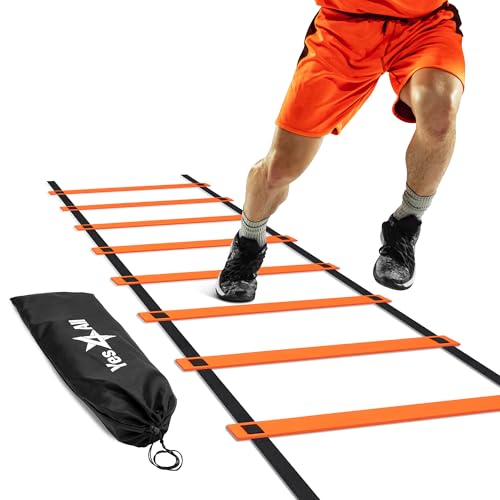
Agility ladder: Yes4All and SKLZ both make widely sold ladder models. Readers comparing options can review the Yes 4 All Agility Ladder Review (2026) and SKLZ Agility Quick Ladder Review (2026) to see how these models are typically described. For a shopping shortlist, search for Yes4All Agility Ladder or SKLZ Agility Quick Ladder. View on Amazon
Agility rings: Look for a set of agility rings marketed for footwork, usually sold in sets of 6 to 12. Several brands offer ring sets, and the product type is what matters most: lightweight, flat rings with a diameter in the range of 18 to 24 inches. View on Amazon
FAQ
Is an agility ladder better than agility rings for basketball?
Neither is strictly better. A ladder builds rhythm and straight-line foot speed, while rings build lateral movement and change of direction. Basketball players usually benefit from both, but the choice depends on which skill needs more work.
How often should I train with agility rings or a ladder?
Two to four sessions per week of 10 to 20 minutes is a common starting point. Keep the intensity high and the rest periods full so that quality stays high. Anyone with joint pain or a recent injury should check with a physical therapist or doctor before starting a new routine.
Can I use agility rings on a basketball court?
Yes. Rings work on hardwood, sport court, and outdoor surfaces. Make sure the rings do not slide on the floor, and use gym-safe ring sets on indoor courts to avoid scuffing.
Do agility rings improve vertical jump?
Rings are primarily a footwork and agility tool. They may support jump mechanics indirectly through better foot placement, but a vertical jump program should include jump-specific training such as plyometrics and strength work.
What if I only have room for one tool?
Pick the one that matches your biggest weakness. If your closeouts and defensive slides feel slow, choose rings. If your first step and transition speed need work, choose a ladder. Add the second tool when space and time allow.
Conclusion
In the agility rings vs ladder comparison, the ladder wins for rhythm, structured patterns, and straight-line foot speed, while agility rings win for lateral movement, change of direction, and small-space training. Basketball players who need defensive footwork will often get more value from rings, while those focused on quick feet and transition speed may prefer a ladder. If you can train with both, alternate them across the week and track your progress with a simple timed drill. For broader planning, consider consulting a strength and conditioning coach, especially if you have a history of ankle or knee problems.

About Weston Reed
Weston focuses on practical advice for basketball endurance & training gear: what matters before you buy, what to skip, and how to get more out of what you already own.
About the author

basketballmarathon editorial team writes reviews and buying guides for Basketball Marathon.